Below are works done by Maria Martinez. I selected these pieces becuase I wanted to compare her work with polychrome ware and her most famous style the black-on-black ware. Her pottery was charecterized by relatively thin walls, hard firing, careful forming, smooth and clear finishes, carefully applied and well-executed designs, and in the case of Black ware, a highly lustrous surface polish. (Maria, 34) Along with the two different styles I am also going to have a piece from when she worked with all three of her family members, which were Julian, Santana, and Popovi Da. I found that when looking at the four pots that not were exactly alike. They are all similar, but not the same. Also, the decorative work in all the painting are different as well. Some may use the same traditional patterns, but the techniques the individual uses is very unique. |
||
.jpg) Image taken from the book "Maria"  Image taken from the website http://www.medicinemangallery.com/Maria-Martinez-article.lasso 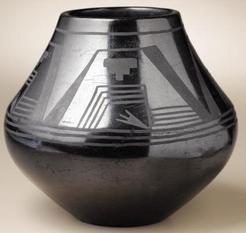 Image taken from the website http://kam.uiuc.edu/collection.cfm?show=decorativearts 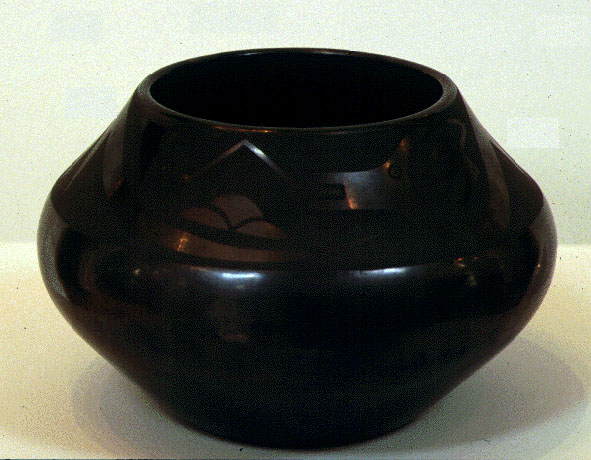 Image taken from the website http://kam.uiuc.edu/collection.cfm?show=decorativearts |
"Snake Pot" this jar is the best known of Maria's and Julian's Polychrome ware, 11 1/4" x 12 1/2" (Maria, 41) Julian designed this pot with multiple commonly used smybols in the San Ildefonso Peublo like the avanyu, which is a water serpent, and many geometric shapes. He uses paints with the traditonal colors of red, black, and cream. This piece is very symetric and also has a range of very bold thick lines to very narrow lines. Each section of the pot follows a different pattern, but still flows together as one piece. I like usage of the curved and straight lines. Image taken from the book "Maria"
Maria and Popovi Da Polychrome Pot, 5" x 7.25" This work by Maria was done while she was working with her son Popovi Da. In the previous Polychrome pot painted by Julian Martinez, it seems to me that he pays more attention to detail. Julian does this by using both thick and thin lines, he also has all three sections of the pot painted (top, middle, bottom). Where in the pot by Popovi Da, he only uses the top half and he also uses more bold or simple objects in his painting. They both use the traditional geometric shapes in their work, especially the white and black checkered line that runs almost in the middle of their pieces.
Image taken from the website http://www.medicinemangallery.com/Maria-Martinez-article.lasso
Maria and Julian Black-on-Black jar. This Black-on-Black jar is painted in matte (which is a non-glossy, dry-looking, and feels somewhat rough to the touch) by Julian. I really like that the entire image is created out different sized lines. I also like the look of the combination between the glossy background and the non-glossy decorative work. This style by Maria and Julian gave them their most success.
Image taken from the website http://kam.uiuc.edu/collection.cfm?show=decorativearts
Burnished Blackware bowl by Maria and Santana. Here they are using an unglazed pot which makes the image harder to see, but they are using the natural properties of the clay. Which was another traditional way of making pottery. They got the blackening by controlling the oxygen while firing. The main image on this pot is the water-serpent, which has been present in other works not just the black-on-black. The water-serpent motif, symbolizing rain, thanksgiving, and prayer for rain. Using the water-serpent it is combining abstract and traditional elements. Even though the image is hard to see I really like that they are trying new things and it a success.
Image taken from the website http://kam.uiuc.edu/collection.cfm?show=decorativearts |
|
